Tag: Walla Walla

  • Unfolding Grandma’s Secret: An Antique World Map Journey

    Unfolding Grandma’s Secret: An Antique World Map Journey

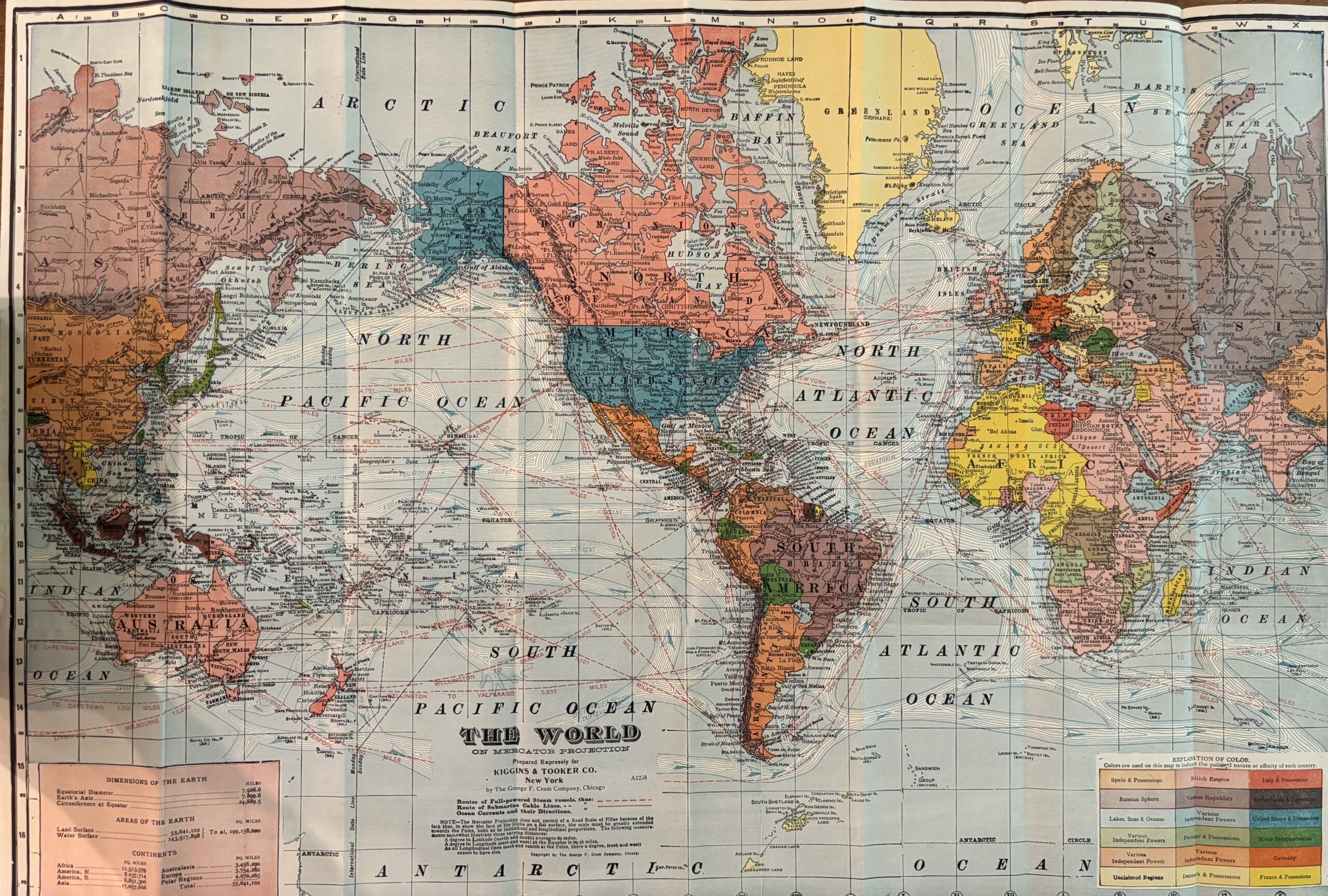
    Today’s exciting find: a historical 103-year-old world map, hidden in Grandma’s steamship travel journal!

    This 1922 antique world map (made by the George F. Cram company, Chicago; for Kiggins and Tooker CO, New York) reveals how far the British Empire and other ruling empires extended. (You can see the color-coding chart, bottom R on the map.)

    The map also includes dashes showing steamship travel paths through the seas.

    This helps me trace where Grandma’s ship sailed and stopped in 1926. The color-coding shows me who ruled the countries she passed through at that time (unless that changed shortly after the map was published.)

    As a bonus, note also the solid lines marked in the seas, indicating submarine cable lines from World War 1.

    (Later in this post you’ll see how the map unfolds from the journal.)

    Sometimes I think my own home is a historical wonderland!

    I have so many boxes of antique handwritten photos, letters, and other memorabilia, it’s easy to lose track of what I have. I joke that I came from a family of hoarders. But I DO relish items hoarded now for over a century which are now in my possession.

    It’s a historical writer’s dream, right?

    For the past year, I’ve searched for such a map online. In the meantime, I had this all along!

    I’m finally working more earnestly on my narrative nonfiction book about the years Gladys Gose Pearce and John Kenneth Pearce lived in India (1923-1933.)

    [My excuse for missing this map: I was temporarily derailed for a few years, assembling and editing a 1950s-1960s collection of vintage scifi short stories, written by yet another family member. See Gremmie’s Reef, now in print.]

    It helps that I’ve now switched my office research piles from vintage science fiction manuscripts back to the India artifacts. So I now have more at my fingertips, including this travel journal.

    Here’s how this antique world map physically unfolds:

    When Gladys wrote in this journal, she’d just begun her steamship journey. It would last 51 days.

    She noted that she boarded the S.S. President Garfield in San Francisco, California in August of 1926. She then had various stops in other countries and ship changes before finally landing in Madras, India to marry Grandpa Ken.

    A bit of their romantic history:

    Ken graduated from high school in Walla Walla, WA with Gladys in 1915. They then both attended the University of Washington in Seattle.

    After college graduation, Gladys went to San Diego to teach.

    In 1923, 25-year-old Ken (J. Kenneth Pearce) was sent to South India, to work as a Forest Engineer for the British Indian government.

    In the fall of 1925, Ken got a short home leave to visit Washington State. He then proposed to Gladys. It was about time! For ten whole years they’d been close friends. But during that visit, sparks flew.

    Gladys and Ken would live in India until 1933: first in South India, and later in the Andaman Islands.

    The Andaman Islands

    The Andamans are tiny specks on this world map, in the Bay of Bengal. The islands are east of the Indian mainland, near Burma (now Myanmar) and Siam (now Thailand.)

    This particular map has the Americas in the center (being published in the USA.) So the R edge of this map shows the mainland of India, while the L edge has the Andaman Islands.

    If you zoom in close you can see where Gladys put an arrow pointing to them. Seeing it on a globe or other-centered map might make it easier to visualize this.

    Still, what a great find this is! I now have this map as my computer screensaver.

    I’m sure the cartographers who drew it 103 years ago could have never imagined THAT.

    What’s in your own attic, basement, or closet? What surprise about your own ancestors awaits you…or have you already found?

    Please share your own discoveries in a comment, or email me via my Contact page. I’d love to hear from you.

    Laurie

  • Legacy of a Walla Walla Pioneer: John Martin Gose (1825-1919)

    While learning about my world-traveling, teacher-athlete grandmother Gladys, I became curious. Had she inherited an adventure gene? What personality traits did she inherit from her Oregon Trail traveling parents and grandparents?

    Digging into the Gose family tree, I found a fascinating guy: Gladys’s pioneer grandpa (my great-great-grandpa).  

    This article was previously published Oct/Nov 2020 in Nostalgia Magazine. That publication includes history about the territories of eastern Washington and northern Idaho.

    Most census records listed the occupation of John M. Gose as “farmer”. Yet additional vintage documents, including near-100-year-old family letters and newspaper articles from the 1800s, reveal his adventurous side.

    Before becoming a well-known agriculturalist, John was a gold-hunter and Oregon Trail traveler. He made three trips across the plains, traveling by foot, covered wagon, or horseback at least 5,312 miles before finally settling in Walla Walla, in Washington Territory.

    As I read more about John, I found it curious that he and his wife Hannah begat a doctor, teacher, and a whole passel of lawyers, including a Washington State Supreme Court Judge. Curious, because as John’s eldest sons grew up, there was not yet a public Walla Walla high school with graduating students, no local college, and no law school in the region. So how did three of those boys become lawyers?

    Let’s set the stage first (or shall I say, stagecoach?) to look at their father’s earlier adventures. John Martin Gose, born in 1825, was raised with eight siblings by a wagon-maker and farmer father. At twenty-four years old, John eagerly headed west from Missouri with the California Gold Rush, seeking adventure and fortune. A scribble in the 1850 census literally lists his profession as “Cal Gold digger” – the same year California became our 32nd state.

    After four years there, John returned to Missouri, bought land, and married 22-year-old Hannah Jane McQuown. The Civil War raged about them as the young couple raised small children while Asra, a nephew, helped them farm. Missouri was war-torn; residents fought on both Union and Confederate sides.

    Asra enlisted at age 17 and was killed in battle a few months later. Perhaps this influenced Hannah’s willingness–with five children under ten years old–to rough it on the rugged Oregon Trail. Anything was better than war.

    In 1864, John and Hannah’s family became part of a nine-wagon train headed west. The Gose family’s oxen pulled three of those covered wagons. Nine-year-old Phelps helped his father John drive one carrying his mother, siblings, bedding and a sheet iron stove. Little Phelps was tireless, walking most of the way. Hannah later said, “The longer we were out, the better he liked to crack that black-snake and call “Gee” or “Haw”’.

    In the bumping, swaying wagon, Hannah minded 8-year-old Dora, 5-year-old “Mack” (McQuown, who’d grow up to be that famed judge), 3-year-old John R., and 1-year-old “Lum” (Christopher Columbus Gose, later called C.C.). John’s brothers Joe and Will drove the two other Gose wagons pulled by oxen and milk cows.

    Hannah later attributed the family’s safety from Indians to the fact they’d had no horses. Details of that journey I found in a handwritten letter to Gladys, from her parents Clara and Phelps.    

     “Your dad wants to tell you the story of their dog, which they started to bring with them. The dog was a Greyhound and some Indians who were at their camp one day were very eager to buy him. Your Gpa was not [interested in] the trade but the Indians, who believed the dog would be great in their chase after deer, antelope and elk, offered him $10 (in gold, of course). He let them take the dog at that price, tho he did not want to sell.

    “The next day, the Indians were back wanting their money. They said the dog gnawed the rope and ran away. This of course in pantomime. Your grandpa did not have any intention of returning the money, but other members of the train who had not ever crossed the plains twice, as your Gpa had, persuaded him that the Indians might make trouble so he gave them back the $10…”

    Found in a letter to my grandmother, Gladys, from her parents, including her father Phelps.

    I imagine the family was in a hurry to press on. Indian attacks on the trail were uncommon, yet had occurred enough to put fear in the travelers. Of equal concern were injuries from wagon wheel accidents, and threats of disease. Cholera, diphtheria, dysentery, and typhoid fever (from contaminated water) were all deadly back then.

    Enroute to Walla Walla, the family wintered in Boise City, Idaho Territory: population 1,658. Archived newspapers from the 1865 Idaho World show announcements for saloons, gold dust exchanges, and stagecoach lines (fare payment in gold or “greenbacks”). For sale were “readers” (school books), wall paper, blasting powder, crockery, tooth brushes, liquors, cigars, cloths, and plows. An ad in one 1865 issue of the Idaho World (Boise City, Idaho Territory) simply stated Bacon, Beans and Lard.

    Communications were via Overland Telegraph, and the Overland Mail via stagecoach. The intercoastal railway was not yet complete. While the little family was still on their journey, in April of 1865, President Lincoln was assassinated.

    July 26th in 1865, John, Hannah and their children arrived in Walla Walla, Washington Territory. Soon Hannah was expecting her sixth child, Oscar.

    In Walla Walla, wheat farming was on its way to becoming the backbone of the region’s economy and John joined in. The children started their education with teachers in rented rooms in town, with attendance fluctuating with farming schedules.

    When Phelps was about eleven years old, the first public school in Walla Walla (and the Inland Empire) was erected –a one-story wooden building. However, there would be no public high school graduates until decades later, so Phelps and his siblings attended Whitman (Seminary) academy for pioneer students.

    When the Gose siblings were young adults and teens, tragedy struck the family. Oscar, their youngest brother, died. Despite their grief, the siblings carried on. Dora became a teacher and Phelps a lawyer–even without a college education.

    Phelps (T.P. Gose) handled cases related to land issues and horse thievery, among other things. Houses of ill fame (brothels) were allowed, but only in a certain part of town. Walla Walla was the largest city in the territory (population over 3,500) until Seattle finally surpassed that. Phelps practiced law for years before Whitman finally became a college (1882) and there was a law school in the region (1889) — the same year Washington finally became a state. 

    So how was Phelps educated? He “read law”: a common way to become a lawyer until the 1890s. This simply meant independently reading authoritative works on law, then taking the bar exam, usually oral, before a judge. Phelps followed the advice of Abraham Lincoln, who had written:

    “Get the books, and read and study them till you understand them in their principal features; and that is the main thing. It is of no consequence to be in a large town while you are reading.”

    Abraham Lincoln, in a letter to Isham Reavis on November 5, 1855 on Reading law.

    Mack F. Gose also read law to become a lawyer, then a Supreme Court Judge for four years in Olympia (1909).

    Brother Lum (C.C. Gose) was first a sheriff, then went to the legislature and passed the bar to join Phelps at Gose & Gose.  

    A newspaper described Lum’s personality glowingly:

    “While he was much admired for his intellectual attainments, it was for the virtues of the heart that he was loved. He was devotedly attached to his family. It was said of him that he never attended a ball game (which as an enthusiast he often did) without being accompanied by his little 10-year-old son, and they were chums in charming comradeship.” 

    Phelps’s personality was similar. He was enormously devoted to his five children. He made sure all, including four daughters and a son, were strongly educated in Walla Walla. They all attended Whitman or the University of Washington—including my grandmother, Gladys.

    For women at that time, that was unusual. The Wa-Hi 1915 yearbook indicated few young women were college-bound, although many earned high school shorthand certification.

    The only Gose brother to leave the region to study was John R, at Jefferson medical college in Philadelphia. He practiced medicine for 17 years, then turned to farming. Which brings us full circle back to their father John’s love of the land. Even in the practice of law, that influenced the brothers Gose. Said of Mack:

    “Judge Gose is the only real farmer we have ever had on the Supreme Court Bench. While he is a brilliant lawyer, he practically devoted his time to farming for some years before going on the bench. He was a real farmer. Above all, he was an honest man and as treads the earth.”

    From an article urging re-election of Judge Mack F Gose, in The Washington Standard (Olympia, Washington) on 30 Oct 1914.

    Love of farming, teaching, and travel, have passed down through six generations. John’s granddaughter, Gladys, became a teacher and expat in India; her daughter Jill, a South American Importer. I, my husband and kids were for a time expats in Norway; my children love world travel.

    While travel methods have changed — from covered wagons, to steamships, to airplanes – it seems there will always be Gose family travelers. Next stop, outer space?
  • A 1915 Yearbook Shows Teen Life 105 Years Ago

    A 1915 Yearbook Shows Teen Life 105 Years Ago

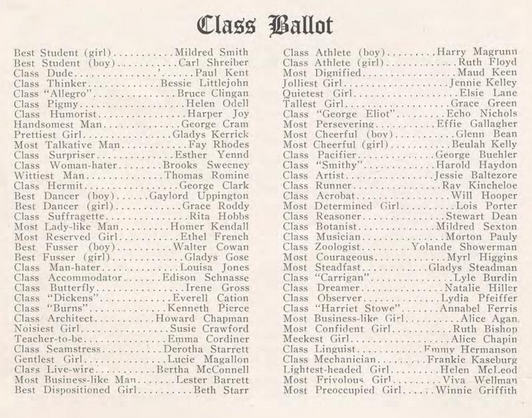
    This digitally archived vintage 1915 yearbook included student nominations for Best Fusser, Class Suffragette, Class “Burns” and Class “Harriet Stowe”.

    1915 WaHi yearbook photo and course descriptions for Gladys Gose at Walla Walla High.

    What great fun it is, reading my grandparents’ 1915 WaHi yearbook, from Walla Walla High in Washington State. It’s like peeking through a window into their teenage personalities!

    I found the digital copy, via Google Search. Yearbooks back then were cleverly written (this one, by the Junior Class) with much detail about their classmates. That high school year, with fewer than 70 Seniors, there was room in the yearbook to playfully describe each graduating student in numerous entries.

    Included was “An Ode to 1915”, a long poem with stanzas for each student. What a kick it was for me to find these, about the teen versions of my Grandma Gladys and Grandpa Ken:

    My! But Gladys was gymnastic, can speak for election;

    And that car they call a “Ford,” she drives it to perfection;

    She went on an English picnic once and now her friends recall

    That in trying to cross the river—she from a log did fall.

    I can easily imagine athletic Gladys trying to cross a river on a log. As for her Ford, it was most likely a Model T. And she did love to talk!

    I also found a stanza about Ken:

    There is a boy in our class whom we are proud to claim;

    He is very studious—Kenneth Pierce is his name.

    He’s won fame in speaking and (perhaps you don’t know it),

    But he is quite famous in the role of a poet.

    Ken’s last name was misspelled Pierce (vs. Pearce) by his classmate. But it was Grandpa, for certain – the only Kenneth in his graduating class. Other places in the yearbook mention Ken’s love for poetry and further display his and Gladys’s personalities:

    Each student was assigned a personal motto:

    It was fun to see that Gladys’s was: “No wild enthusiast ever yet could resist”.

    That certainly fits a girl who would later hop a steamship to India!  I knew that Grandma played basketball, but it was revealing to see she was involved in drama, speaking, singing, speaking competitions, and organizing social events.

    The motto assigned to Ken was: “Night after night, he sat and bleared his eyes with books.”

    He definitely was a studious one, graduating that year from high school at only age 16. He played the violin, and in the school’s “House of Representatives” loved leadership and debate. (Later at the young age of 25, he’d be put in a role of leadership in India.)

    But as you’ll see, he was also very playful.

    Quick aside: I originally sought out this yearbook to see Ken’s high school graduation picture. That’s because Gladys, in a letter written ten years later, wrote that the boy she once knew had filled out as a man, and had “a very fine mustache”.

    It’s easy to see his little-boy looks in his high school photo at age 16:

    1915 WaHi yearbook photo, Kenneth Pearce, Walla Walla High.

    Here’s a different picture showing what he looked like nearly ten years later, when she fell in love with him. (I found this one among family photos.) I couldn’t figure out why they were “just friends” for so many years. He certainly did grow up after high school.

    J. Kenneth Pearce photo, late 1920s. Pearce Family Collection, Laurie Winslow Sargent

    The Class Ballot offered clues about personalities, plus 1920s events:

    Class Ballot from the 1915 Wa-Hi yearbook, published in 1916. Includes student nominations for Best Fusser, Class Suffragette, Class “Burns” and Class “Harriet Stowe”.
    [Class Ballot: from the 1915 Wa-Hi yearbook, published in 1916.]

    It’s interesting that there were nominations for such things as Class Suffragette (women still did not have the right to vote) and Class “Harriet Stowe”. I assume the latter referred to Harriet Beecher Stowe, author of Uncle Tom’s Cabin and that this classmate a vocal abolitionist.

    As for “Class Pigmy”, “Noisiest Girl”, or “Lightest-headed Girl” — those weren’t terrifically flattering. Other girls were probably OK with “Jolliest Girl” and “Class Zoologist”.

    “Best Fusser” for Gladys mystifies me, only because I can’t figure out what the word meant back then, in this context. The common dictionary definition of a “fusser” is someone overly concerned with details. It does seem from other entrees in the yearbook that Gladys was a busy-bee. Perhaps she loved overseeing details in her role on the Student Entertainment Committee.

    I see Grandpa Ken (last name spelled Pierce again) voted “Class ‘Burns’” as in the famed Scottish poet, Robert Burns. Sure enough, in some of  Ken’s later love letters to Grandma, he quoting Burns’ love poetry!

    The 1915 yearbook also included fictional stories and predictions

    One fiction story in the book was ‘On the Little Pend o’Reille’” by Kenneth Pearce, in which Ken wrote about a dramatic cougar attack. (I’ll put it in another blog post later, as it’s quite exciting.)

    Another student writer, Lois Porter, wrote predictions of the future for each student, based on their personalities. It was a bit like the “Most Likely To…” lists you see in modern yearbooks, but with a playful twist. She began it:

    In the city of Walla Walla, by the city of Milton, by the city of Dixie, lived a people wise and courageous, brave and athletic, the tribe of the Seniors, the children of the Walla Wallans; and their abode was Walla Walla High School.

    Lois Porter, 1915 WaHi Yearbook

    About Gladys, she wrote: “Thou, O Gladys Gose, shalt mighty waters cross. In a strange language with strange people and in strange lands shalt thy voice rise in anthems of glad tidings.”

    I suspect that teen Gladys must have talked of wanting to travel. It would be eight years before she actually crossed any “mighty waters to strange lands”.

    Here was Ken’s:

    “Thou, O Myrl Higgins, O Lucy Magallon, O Kenneth Pierce, O Winnie Griffith, and thou, too, O Harold Hayden, shall cast thy lot together and members of the Kalem Company shalt thou become. Exciting and romantic shall be thy future…”

    The Kalem Company was an early American silent film studio founded in NY City in 1907.

    Indeed, Grandpa enjoyed drama. In the Senior Play, Manoeuvers of Jane, he played Prebendery Bostock. (Gladys played Constantia Gage.) A decade later, Ken would write Gladys from his ship to India that he’d dressed up as a flapper for a masquerade party, to the horror of the missionaries onboard (and now to my amusement)!

    After Gladys joined him, they would act in the play The Importance of Being Earnest to entertain a small group of British friends. (During the Raj era, acting in plays was a common way for expats to make their own entertainment). However, Ken’s future work would be as a logging engineer—a bit  more sedate than work as a silent film actor.

    Slang and Sports

    Some slang in the yearbook was unique to that era:

    “… we are not “digs”, for we manage to have a good time wherever we go. If we do not get it in the study hall with paper wads, we get it in the gymnasium at parties and dances.”

    But any athletic teen today can relate to excitement over sporting events, including a basketball game (in which I proudly say Gladys played Center):

    “A great deal of enthusiasm had been worked up and many guesses were made as to the winners of the girls’ and boys’ inter-class basketball series. The girls’ games were played first, starting Wednesday, December 2. On this date, the seats in the gymnasium were crowded to the limit and everywhere class spirit was shown by the yelling and shouting of the class rooters.”

    There’s so much more I discovered in this yearbook. I’ll summarize by saying the yearbook naturally included courses of study (many though, I didn’t expect to see in a 1915 high school) and photos of athletes in 1915 sports attire and in various clubs. The yearbook also included ads from local businesses (1920s prices, of course) cartoons, and jokes. I spent hours poking through the yearbook — more entertaining for me that the average Netflix movie and certainly more fun that reading current pandemic news.

    A good end note to this post is the Last Will and Testament of the Senior Class, where items were ‘willed to’ the Juniors. That included ”the new swinging locker doors with which to dent your skulls,” and “the nerve racking game of Town Ball,” another version of baseball.

    As a writer my urge to correct that spelling of nerve-wracking is overwhelming, but I do resist editing words written by teens 105 years ago.

    To read the 1915 yearbook in full, click here: WA-HI Yearbook — have fun looking at the ads, too: you could buy a new Ford for only $440.

    Fellow writers or genealogy fans: you may have as much fun researching your own family members’ vintage yearbooks. Leave a comment with any questions or tell me what you discover!

  • 1929: New Motherhood in Ooty

    1929: New Motherhood in Ooty

    In 1929, expat Gladys sent this sweet note on motherhood from Ooty, South India to her mother in Walla Walla, Washington.

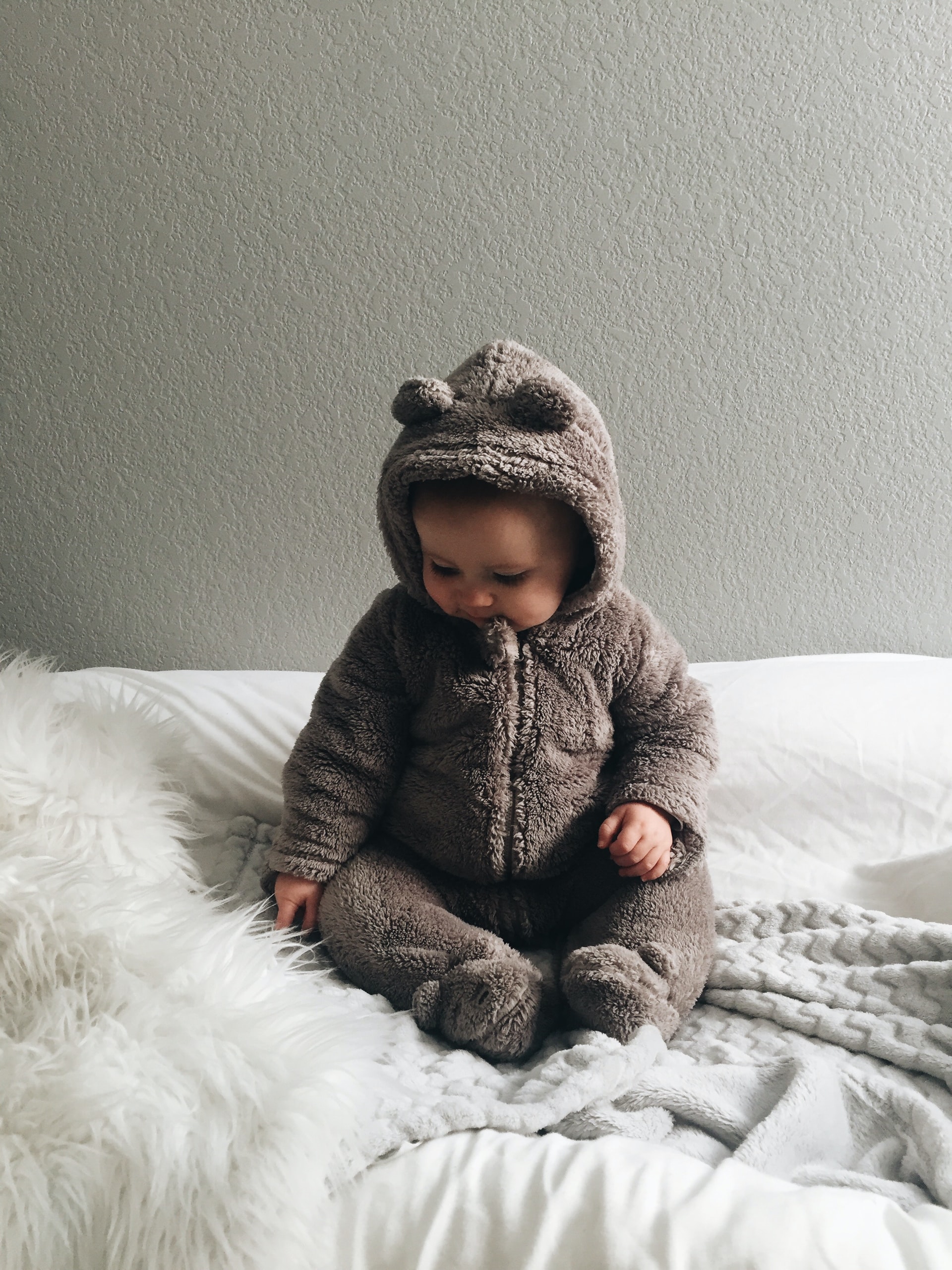
    Baby in a teddy bear suit.
    Photo by Brytny.com on Unsplash

    Today, I (Laurie) in 2020 had the delight of Skyping with my daughter and grand-babies. In this modern age of motherhood and grandmotherhood, I can see them instantly. I can even capture video or screenshots of them while we video-chat! My oldest granddaughter, 2 1/2 years old, is so accustomed to this she is mystified when we have a regular phone call. “Grandmama? Grandmama? I can’t see you!”

    But nearly a century ago, news from Gladys to her mother about her babies took ages to arrive. Letters and photos traveled via very long, slow steamships from India to America.

    She and her husband Ken, a forestry expert from Seattle, were living at Ootacamund Hill Station among British officers (and occasional royalty) during the British Raj era.

    Gladys, who loved to write, used sweet prose to describe her newborn:

    Braemar, Ootacamund Hill Station

    7 May, 1929

    Dear Mother and Dad,

    I’ve just tucked Pamela, now seven weeks old, in her little bed. She is a fascinating little miss. The last I saw, she had both little hands flying back and forth and she was agoo-ing for all she was worth. Not a whimper when I left and the light went off. Her little bed is alongside ours so I know what she is doing. 

    She is getting so plump — little dimples in her elbows and back and one below her little mouth at one corner. The other day, three children came to see her and she cooed and “talked” to them in the cunningest way I’ve ever seen. Babies seem to speak to other children in a language we do not understand.

    Pamela as yet refuses to let us know what color her hair is, and whether it is to be straight or curly. Her first hair was brown and decidedly straight. Now her little head is covered with a fine down that at times looks yellow and at other times brown with auburn lights.

    She has very keen eyes. When she awakens they just shine and she reminds me of a little bird. Her mouth is an adorable rosebud and she is just finding her tongue and loves making gurgling noises, and then looks so surprised and delighted. She is now placing the direction from which sounds come, like approaching footsteps. Most gratifying of all, she knows me.

    The monsoon has come early. We have heavy rain every afternoon and evening. Tonight it simply pelted down. There was some hail in it. 

    There are beautiful walks out from Braemar. Now the rain has settled the dust, it is nicer than ever. Sunday home mail brought by the last ship was a tremendous success: I got 11 letters. I scarcely know where to begin answering them.

    I am knitting a pull-on teddy bear suit for baby for travel. Pamela sends a kiss to each of her grandparents, and says tell you she will be coming home to you soon for home leave. I also send love and much of it.

    Your daughter, Gladys

    From Laurie: Isn’t it funny that teddy bear outfits are still considered cute on babies? My own grand-babies have a few sweater hoods with bear ears!