Tag: Laurie Winslow Sargent

  • A Mysterious 1938 4th Grade Report Card

    A Mysterious 1938 4th Grade Report Card

    This post is in the series Stories from Family Memorabilia, on researching family history, via odd objects and papers.

    Today’s historical mystery is a 1938 4th Grade report card. It’s a strange report, from an odd location.

    And as usual, I can’t pick up any old family paper without it stimulating my curiosity. Like Paul Harvey, the old American radio broadcaster, I want “the rest of the story.”

    Despite the missing first name on this paper, I realize quickly I’m looking at my dad’s report card, since in 1938 he was 10 years old. Still, I noticed odd things about this report.

    Harsh Teachers

    For starters, one teacher’s comments were over-the-top insensitive. I’m not a fan of participation trophies, so mentioning he was sloppy or untidy was acceptable. But for his English teacher, H.D.H., to call him–any kid!–“lazy and unintelligent” raised my Mama hackles.

    Dad as an adult was both industrious and bright, working as a creative landscape architect. So I put on my psych cap. (I formerly worked in both psychiatric and educational Occupational Therapy.) What the heck was going on with Dad at age 10?

    Words from less harsh teachers described him in this report as “content with something much less than his best”, “aught to have done better”, “inclined to be erratic”, “rather mischievous”, disobedient, silly, slack, and forgetful. Ooooh, this is beginning to sound like a boy who had potential, but didn’t give a rip. But why?

    Conversely, his French teacher wrote “He is keen and intelligent and well ahead for his age.” His Scripture teacher wrote “listens well and answers intelligently.” And while Dad was 10, the average age of the class was 11 years old. Hmm. I’ve worked with gifted children who misbehaved out of sheer boredom.

    Children on the Move

    Finally I notice the words at the top: Form: “Remove” and in the tiniest cursive imaginable at the bottom of the report, “Knowing he is leaving has unsettled him, I think.”

    So Dad was leaving. To go where? And where, in the world (literally) was this school, teaching French and Latin to 4th graders?

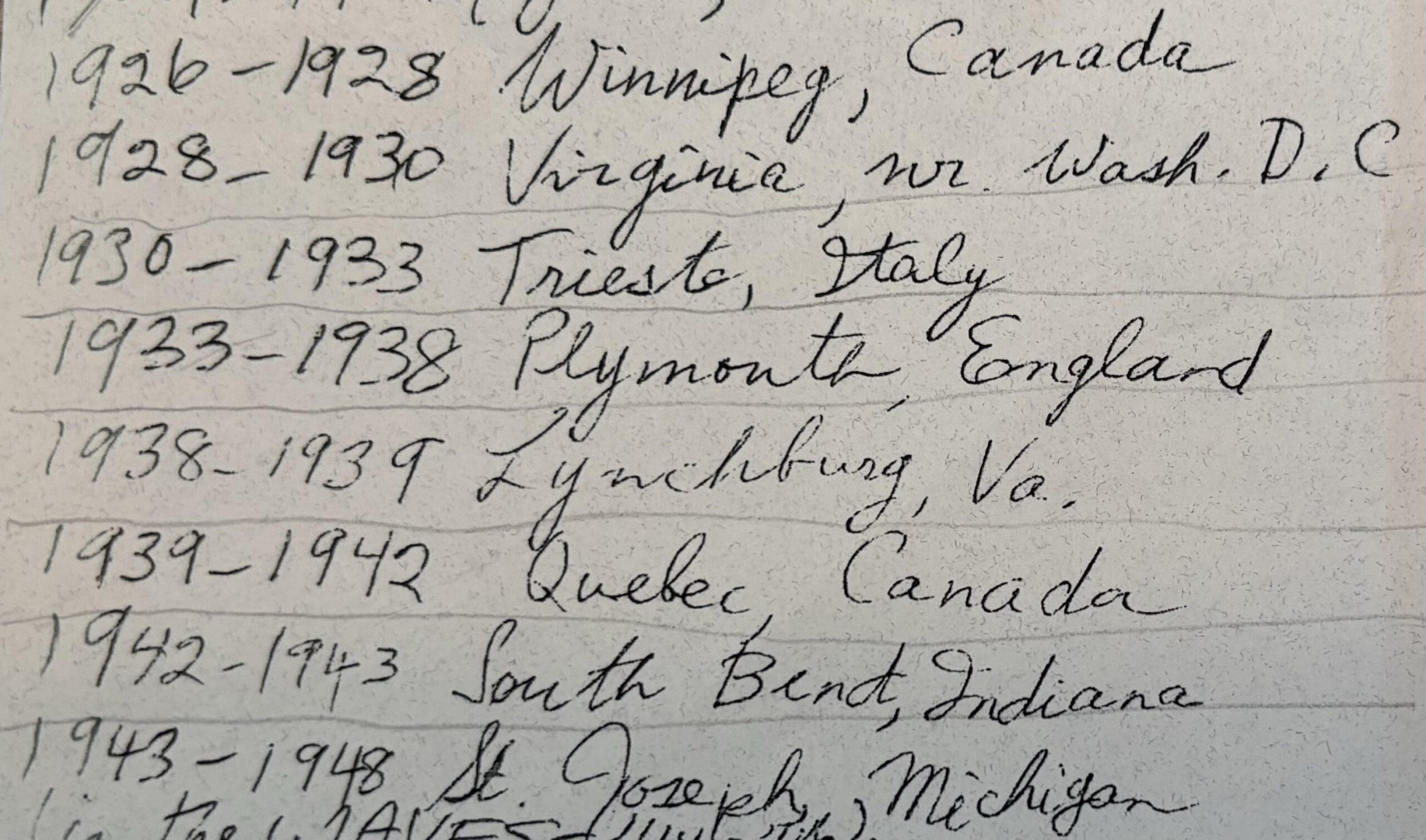
    The odds were high he had just come from another country, and soon leaving for another. You see, Dad was the son of an American foreign service officer. I have a list of dates of dates and places where Dad’s family lived.

    This list below, created by one of Dad’s sisters, reveals that Dad moved four times in his first 10 years of life. Born in Winnipeg Canada, he then lived in Arlington Virginia, Trieste Italy, and Plymouth England, then later that same year to Lynchburg, VA.

    List of places Don Winslow lived including Winnipeg, Canada, Trieste, Italy, and Plymouth England.
    Dad was born in 1928. He lived in four countries before age ten.

    Where was Ravenswood School?

    The location of Ravenswood School puzzled me. In 1938 Dad lived in two places. Historical sites for Lynchburg don’t show any school by that name, yet four hours from there is the town of Ravenswood, West Virginia. Three schools there had the name Ravenswood.

    I found in my ancestry app that while Dad was at Ravenswood (in January) his grandmother had died in Lynchburg.

    So the Lynchburg timing was right. But wait! But why would they dump him in a school four hours away at age 10, unless it was a boarding school? They didn’t have boarding schools in WV, right?

    Also unusual to me was the inclusion of Latin and French in an American 4th Grade classroom, even in 1938. The wording was weird too: “Form 4” instead of “Grade 4” with the school term was labeled “Easter.”

    I called my lifeline (my brother) who said dad had been in a boarding school at some point in his life. So thinking the town of Ravenswood, WV might be a red herring, I Googled Plymouth, England. Lo and behold, there was a Ravenswood School in England, too.

    Then began a deep dive for me down a dark hole for two days.

    British boarding schools for 8-year olds?!

    That Ravenswood was indeed a boarding school. And from the dates on the report card, I realized Dad had been there at ages 9 and 10. Possibly at even a younger age. WHAT?

    Although my grandparents were American, it was particularly common for children of diplomats and others in working government service in other countries to send their children to boarding schools. The justification for it was that it would supposedly give children more stability and an excellent education.

    But for some reason, I always thought this involved the teen years, not children still clutching teddy bears and wanting mom to read bedtime stories to them.

    Then I found the website Boarding School Survivors: Therapeutic help for those affected by boarding, created by Nick Duffell, also author of the book The Making of Them: The British Attitude to Children and the Boarding School System.

    I was shocked to finally understand one of the lines in tiny print at the bottom of Dad’s report card: “too many stripes for silly behavior and disobedience.” That meant beatings with a cane. I was also distressed reading about how much bullying and even more extreme abuse took place within early boarding schools, meted out by older children.

    Dad, born in February, at the time of this report card was only 10 years and 1 month old, so the report was mostly about his behavior at age 9.

    Boarding school documentaries reveal harsh truths

    I then watched two documentaries on YouTube showing 8 year olds being sent off to boarding school in more recent years. I was disturbed by how it distressed those particularly young children. Leaving Home At Eight | Boarding School Children follows four little girls, and The Making of Them (1994) (also connected with Nick Duffell) several 8 and 9-year-old boys.

    Listening to one little boy in the latter documentary broke my heart. He had quickly learned to shut down his emotions and be a brave little man. Boys who cried for their mothers were particularly targeted for bullying.

    Strangely, those two modern documentaries revealed distress in some of the mothers who felt pressured to send their kids to boarding schools. They were truly persuaded it would be good for them. Some believed it would give their children more stability, what with the family moving often with Dad’s work. Many of these women had husbands who had been in boarding schools themselves, so for the fathers that was all they knew.

    I urge you to watch those documentaries, but with a tissue handy.

    Raising resilient kids at on the move

    This deep dive has me appreciating the permission I always had, being an American, to educate my children in a variety of ways and even when moving to new locations. As a child, I moved every three years: Dad had apparently caught the moving bug.

    I feel that caused growth in me as child and helped me to learn to adapt well. My husband and I while raising our three children lived in three different U.S. states and one other country (Norway.) Of course, it was not always easy for the kids changing schools. But they all grew into adults who love to travel.

    Educationally, depending on each of my own child’s individual needs, we used a variety of methods. Our children experienced a mix of public school (including in Norway) and home school–depending on each one’s individual needs at the time–growing up to be brilliant and loving adults now teaching their own children to explore.

    Fresh understanding

    Now I know more than I wanted to know from a single piece of paper from my vintage paper pile. But it’s got me thinking about my dad and how it may have affected him.

    It also has given me more insight into my Grandmother’s writings about living in British Raj, India. She had commented with some horror on young children being sent away from India to England to boarding schools, while both parents remained in India. Once they were shipped off, some children didn’t see their parents for years. Grandma had come from an extremely tight and loving family, so this shook her.

    I want to weep for all the precious moments British moms missed (as did my Dad’s American mom) with their children in boarding school. Some of you know I wrote a book called Delight in Your Child’s Design (Second Edition, Kindle) so know my passion for that. I can only hope that those moms now know there are ways to educate children well, while keeping them close.
  • The Tragedy of Henry Diddoh: a 1950s Frankenstein-ish story in Reawakened Worlds

    The Tragedy of Henry Diddoh: a 1950s Frankenstein-ish story in Reawakened Worlds

    In John Hayden Howard‘s vintage sci-fi anthology Reawakened Worlds, Vol One–now re-titled GREMMIE’S REEF, Henry and Hank share a strange and untenable bond.

    This novelette by John Hayden Howard, written in 1951, kicks off this collection of stories with a bang. Or I should say, with a headset.

    Here’s the gist of the Diddoh story (the first of eight stories in the Gremmie’s Reef :

    Henry is a professor, leading an extremely predictable and somewhat boring life. He’s considering a few life-changing options. Suddenly a third, more macabre choice presents itself:

    Image with Kindle quote: Fortunately, or perhaps unfortunately, as the result of a long, off-the-record talk with Professor Renworth of the Physiology Department concerning an unusual experiment, Henry's choices increased to three. Henry Diddoh paid his fated visit to the lab where Renworth, a dabbler in neural electronics, was probing a handsome cadaver. The body's lifelike twitching made Henry's Adam's apple return distress signals.
    (Image links to Gremmie’s Reef)

    Henry opts to connect his brain to the body of that once-a-cadaver. The idea is to allow him to be in two places at the same time–to accomplish more. I think that could be useful– what if I could write a book at home while also being with my grandchildren in another state? What would you do if you could be in two places at the same time?

    At first, for Henry, it seems exciting:

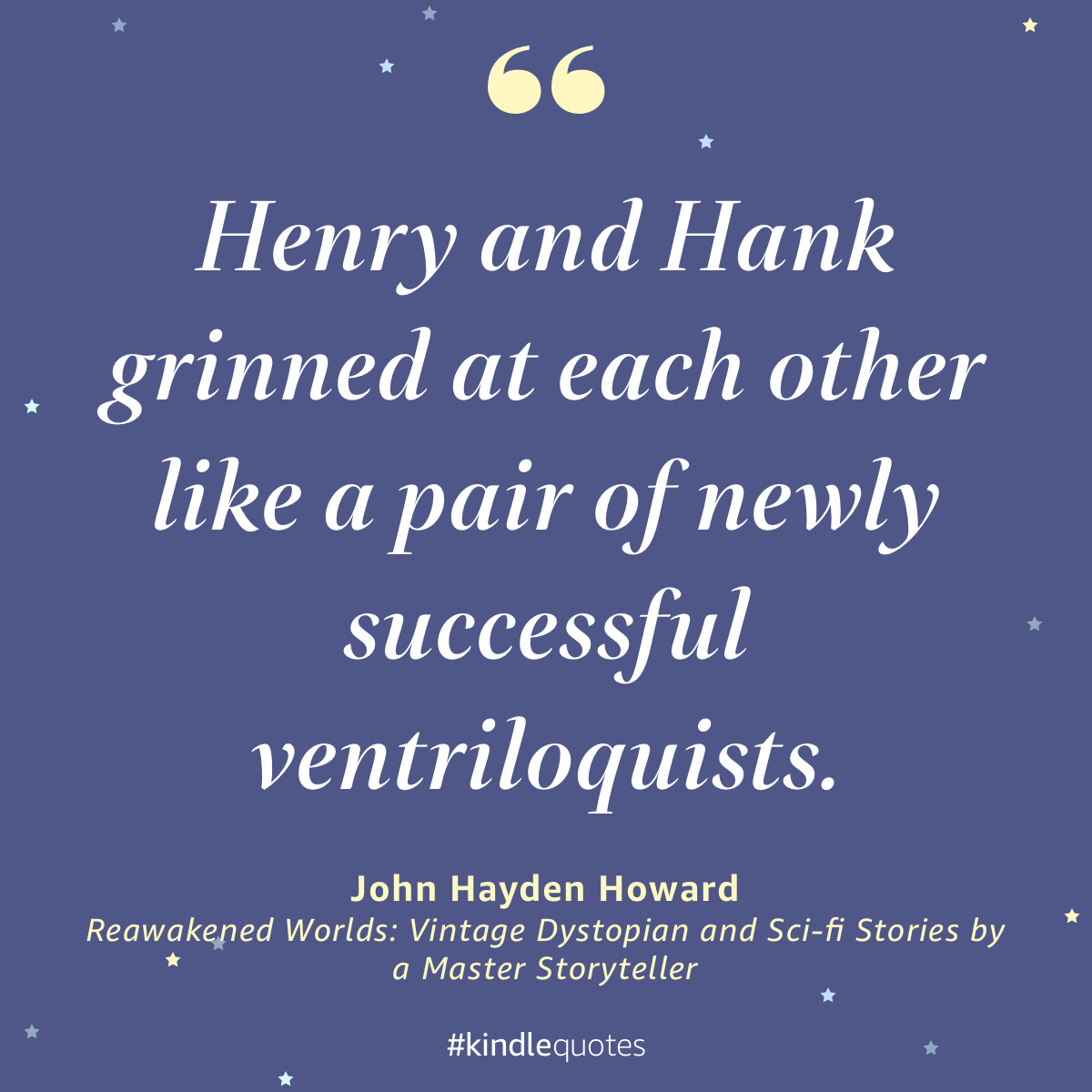
    Kindle Quote: Henry and Hank grinned at each other like a pair of newly successful ventriloquists.
    (From the story The Tragedy of Henry Diddoh)

    But as the story progresses, Henry’s bizarre attempt to manipulate Hank’s brain becomes problematic. Hank desperately wants to be independent–to be his own person and have his own family. Yet the two men are inexorably tied together.

    Kindle Quote: The professor had underestimated him. He was a man now. And as Hank walked the streets, he worried about summer, when the experiment with him might end. Soon Hank found he did not have to sleep just because Henry dozed off. Yet he did learn that when he took a bus out of the city, he had to pull the stop cord at about 20 miles from Henry. If he traveled much farther, his sight blurred.
    (Image links to the Reawakened Worlds Vol 1 audio book.)

    As this vintage sci-fi story progresses, I find myself rooting for Hank, although he does commit a murder in self-defense. And being permanently tied to Henry is impossible, leading to a dramatic ending to the story.

    To truly immerse yourself in the story and enjoy Howard’s unique storytelling skills, you can find the full story, along with seven other stories, in the anthology in Gremmie’s Reef. But if you’ve already read “The Tragedy of Henry Diddoh,” in this book under its previous title (now the subtitle) Reawakened Worlds Vol 1, can you tell me what you liked about it in a comment below?

    As compiler and editor of this anthology series, I’ve gone over all the stories multiple times. Yet with each read I end up pondering a different aspect of this story. I’d love to hear your own thoughts.

    Laurie

    All stories in the Reawakened Worlds Series were written between 1950 and 1977, including some previously published stories. Copyright of the author’s stories belongs to the Estate of John Hayden Howard, managed by Laurie Winslow Sargent @LaurieSargent

  • New Book: I Still Matter

    Book cover image for I Still Matter: Finding Meaning in Your Life at Any Age, compiled by Harlan Rector and Edward Mickolus with contributor Laurie Winslow Sargent.
    I Still Matter, by Harlan A. Rector and Edward F. Mickolus

    I Still Matter is a new book that encourages gratefulness. It was compiled by Harlan Rector, movie trailer voice-over artist, and Edward Mickolus, 33 years in the CIA and a prolific author. I’m pleased to have a story of my own, The One, in I Still Matter.

    Sometimes we as authors have a story itching to be told. It’s a marvelous thing when, simultaneously, someone compiling a book asks if we happen to have a story to contribute.

    Harlan Rector and Edward Mickolus both have remarkable, yet widely different, histories. What they have in common is a love for good stories, leading them to co-create the I Matter three-book series, of which the most recent is: I Still Matter: Finding Meaning in Your Life at Any Age, published last month.

    Harlan Rector and Edward Mickolus

    When I first met Harlan at church, I was most impressed with his kind manner and the tenderness and care he shows his wife, who he’s been married to for 65 years. He is the epitome of gratefulness.

    I had no idea at the time I’d met a famous voice-over artist. You can hear his recognizable voice in trailers for movies including Maleficent and Night at the Museum, and in a video game trailer for Harry Potter, PlayStation 2, Harry Potter. Harlan was the signature voice of The History Channel between 1995 and 1999.

    He’s also been a caricature artist, and producer of a radio series and a musical. In movies, he’s the voice of The System in the short sci-fi film, EVT (Winner Best Film, St. Louis 48 Hour Film Project 2014) and narrator for the 1990 TV Movie and documentary, What’s Up, Doc? A Salute to Bugs Bunny (1990). You can hear more voice-overs at his website, HarlanRector.com. I instantly recognized his voice in commercials advertising Quaker Oats, Chevy, etc. His voice-over for Folgers coffee reminds me of “the best part of waking up”. It’s a strange sensation to know someone’s voice before ever meeting them!

    Edward worked in the Central Intelligence Agency for 33 years (in analytical, operational, management positions), receiving CIA Career Intelligence and the Clandestine Service Medals. He’s the author of 40 non-fiction books and 100+ articles and reviews, including titles on topics related to international terrorism. Fellow writers will appreciate his title Spycraft for Thriller Writers: How to Write Spy Novels, TV Shows and Movies Accurately and Not Be Laughed at by Real-Life Spies. But he has a funny side too, contributing humor to 14 publications.

    I Still Matter (and you do too!)

    Their latest book, I Still Matter, is an anthology of stories from 35 authors about how people influence us for good, and how we can make a difference in others’ lives and inspire them.

    My own story in it, “The One”, is about a miracle that connected me with a reader of my own parenting books on the other side of the world, in the Philippines. We have mutually encouraged each other for eighteen years since. I’ve had the chance to see–through Facebook–her children grow from preschoolers to college graduates. That story was a good fit for this I Matter book, showing how people can impact our lives in unusual ways. I feel not only gratefulness for the miracle that inspired that story, but also for my opportunity to connect with Harlan and Edward. They enrich my own life as I hear their unusual life stories.

    Who has impacted you and how? Tell them, if you can. They may need to hear that today. You can also leave a comment below about someone who has affected you mightily.

    Most likely there are many people grateful for you, too.

    Laurie

  • Legacy of a Walla Walla Pioneer: John Martin Gose (1825-1919)

    While learning about my world-traveling, teacher-athlete grandmother Gladys, I became curious. Had she inherited an adventure gene? What personality traits did she inherit from her Oregon Trail traveling parents and grandparents?

    Digging into the Gose family tree, I found a fascinating guy: Gladys’s pioneer grandpa (my great-great-grandpa).  

    This article was previously published Oct/Nov 2020 in Nostalgia Magazine. That publication includes history about the territories of eastern Washington and northern Idaho.

    Most census records listed the occupation of John M. Gose as “farmer”. Yet additional vintage documents, including near-100-year-old family letters and newspaper articles from the 1800s, reveal his adventurous side.

    Before becoming a well-known agriculturalist, John was a gold-hunter and Oregon Trail traveler. He made three trips across the plains, traveling by foot, covered wagon, or horseback at least 5,312 miles before finally settling in Walla Walla, in Washington Territory.

    As I read more about John, I found it curious that he and his wife Hannah begat a doctor, teacher, and a whole passel of lawyers, including a Washington State Supreme Court Judge. Curious, because as John’s eldest sons grew up, there was not yet a public Walla Walla high school with graduating students, no local college, and no law school in the region. So how did three of those boys become lawyers?

    Let’s set the stage first (or shall I say, stagecoach?) to look at their father’s earlier adventures. John Martin Gose, born in 1825, was raised with eight siblings by a wagon-maker and farmer father. At twenty-four years old, John eagerly headed west from Missouri with the California Gold Rush, seeking adventure and fortune. A scribble in the 1850 census literally lists his profession as “Cal Gold digger” – the same year California became our 32nd state.

    After four years there, John returned to Missouri, bought land, and married 22-year-old Hannah Jane McQuown. The Civil War raged about them as the young couple raised small children while Asra, a nephew, helped them farm. Missouri was war-torn; residents fought on both Union and Confederate sides.

    Asra enlisted at age 17 and was killed in battle a few months later. Perhaps this influenced Hannah’s willingness–with five children under ten years old–to rough it on the rugged Oregon Trail. Anything was better than war.

    In 1864, John and Hannah’s family became part of a nine-wagon train headed west. The Gose family’s oxen pulled three of those covered wagons. Nine-year-old Phelps helped his father John drive one carrying his mother, siblings, bedding and a sheet iron stove. Little Phelps was tireless, walking most of the way. Hannah later said, “The longer we were out, the better he liked to crack that black-snake and call “Gee” or “Haw”’.

    In the bumping, swaying wagon, Hannah minded 8-year-old Dora, 5-year-old “Mack” (McQuown, who’d grow up to be that famed judge), 3-year-old John R., and 1-year-old “Lum” (Christopher Columbus Gose, later called C.C.). John’s brothers Joe and Will drove the two other Gose wagons pulled by oxen and milk cows.

    Hannah later attributed the family’s safety from Indians to the fact they’d had no horses. Details of that journey I found in a handwritten letter to Gladys, from her parents Clara and Phelps.    

     “Your dad wants to tell you the story of their dog, which they started to bring with them. The dog was a Greyhound and some Indians who were at their camp one day were very eager to buy him. Your Gpa was not [interested in] the trade but the Indians, who believed the dog would be great in their chase after deer, antelope and elk, offered him $10 (in gold, of course). He let them take the dog at that price, tho he did not want to sell.

    “The next day, the Indians were back wanting their money. They said the dog gnawed the rope and ran away. This of course in pantomime. Your grandpa did not have any intention of returning the money, but other members of the train who had not ever crossed the plains twice, as your Gpa had, persuaded him that the Indians might make trouble so he gave them back the $10…”

    Found in a letter to my grandmother, Gladys, from her parents, including her father Phelps.

    I imagine the family was in a hurry to press on. Indian attacks on the trail were uncommon, yet had occurred enough to put fear in the travelers. Of equal concern were injuries from wagon wheel accidents, and threats of disease. Cholera, diphtheria, dysentery, and typhoid fever (from contaminated water) were all deadly back then.

    Enroute to Walla Walla, the family wintered in Boise City, Idaho Territory: population 1,658. Archived newspapers from the 1865 Idaho World show announcements for saloons, gold dust exchanges, and stagecoach lines (fare payment in gold or “greenbacks”). For sale were “readers” (school books), wall paper, blasting powder, crockery, tooth brushes, liquors, cigars, cloths, and plows. An ad in one 1865 issue of the Idaho World (Boise City, Idaho Territory) simply stated Bacon, Beans and Lard.

    Communications were via Overland Telegraph, and the Overland Mail via stagecoach. The intercoastal railway was not yet complete. While the little family was still on their journey, in April of 1865, President Lincoln was assassinated.

    July 26th in 1865, John, Hannah and their children arrived in Walla Walla, Washington Territory. Soon Hannah was expecting her sixth child, Oscar.

    In Walla Walla, wheat farming was on its way to becoming the backbone of the region’s economy and John joined in. The children started their education with teachers in rented rooms in town, with attendance fluctuating with farming schedules.

    When Phelps was about eleven years old, the first public school in Walla Walla (and the Inland Empire) was erected –a one-story wooden building. However, there would be no public high school graduates until decades later, so Phelps and his siblings attended Whitman (Seminary) academy for pioneer students.

    When the Gose siblings were young adults and teens, tragedy struck the family. Oscar, their youngest brother, died. Despite their grief, the siblings carried on. Dora became a teacher and Phelps a lawyer–even without a college education.

    Phelps (T.P. Gose) handled cases related to land issues and horse thievery, among other things. Houses of ill fame (brothels) were allowed, but only in a certain part of town. Walla Walla was the largest city in the territory (population over 3,500) until Seattle finally surpassed that. Phelps practiced law for years before Whitman finally became a college (1882) and there was a law school in the region (1889) — the same year Washington finally became a state. 

    So how was Phelps educated? He “read law”: a common way to become a lawyer until the 1890s. This simply meant independently reading authoritative works on law, then taking the bar exam, usually oral, before a judge. Phelps followed the advice of Abraham Lincoln, who had written:

    “Get the books, and read and study them till you understand them in their principal features; and that is the main thing. It is of no consequence to be in a large town while you are reading.”

    Abraham Lincoln, in a letter to Isham Reavis on November 5, 1855 on Reading law.

    Mack F. Gose also read law to become a lawyer, then a Supreme Court Judge for four years in Olympia (1909).

    Brother Lum (C.C. Gose) was first a sheriff, then went to the legislature and passed the bar to join Phelps at Gose & Gose.  

    A newspaper described Lum’s personality glowingly:

    “While he was much admired for his intellectual attainments, it was for the virtues of the heart that he was loved. He was devotedly attached to his family. It was said of him that he never attended a ball game (which as an enthusiast he often did) without being accompanied by his little 10-year-old son, and they were chums in charming comradeship.” 

    Phelps’s personality was similar. He was enormously devoted to his five children. He made sure all, including four daughters and a son, were strongly educated in Walla Walla. They all attended Whitman or the University of Washington—including my grandmother, Gladys.

    For women at that time, that was unusual. The Wa-Hi 1915 yearbook indicated few young women were college-bound, although many earned high school shorthand certification.

    The only Gose brother to leave the region to study was John R, at Jefferson medical college in Philadelphia. He practiced medicine for 17 years, then turned to farming. Which brings us full circle back to their father John’s love of the land. Even in the practice of law, that influenced the brothers Gose. Said of Mack:

    “Judge Gose is the only real farmer we have ever had on the Supreme Court Bench. While he is a brilliant lawyer, he practically devoted his time to farming for some years before going on the bench. He was a real farmer. Above all, he was an honest man and as treads the earth.”

    From an article urging re-election of Judge Mack F Gose, in The Washington Standard (Olympia, Washington) on 30 Oct 1914.

    Love of farming, teaching, and travel, have passed down through six generations. John’s granddaughter, Gladys, became a teacher and expat in India; her daughter Jill, a South American Importer. I, my husband and kids were for a time expats in Norway; my children love world travel.

    While travel methods have changed — from covered wagons, to steamships, to airplanes – it seems there will always be Gose family travelers. Next stop, outer space?